Just another entry in the “collecting evidence for my future self” series. There’s no subheadings in this one so prepare yourself for some stream-of-consciousness.
Since moving to Perth five years ago I’ve seemingly been unable to keep myself away from further tertiary study for very long.
In 2020/2021 I enrolled in a BA and studied two units of philosophy at Macquarie University.
In 2022 I enrolled in a BSc and studied two units of chemistry as well as electives in philosophy and political science at The University of Western Australia.
In 2023 I studied individual units in game design and creative writing at Curtin University.
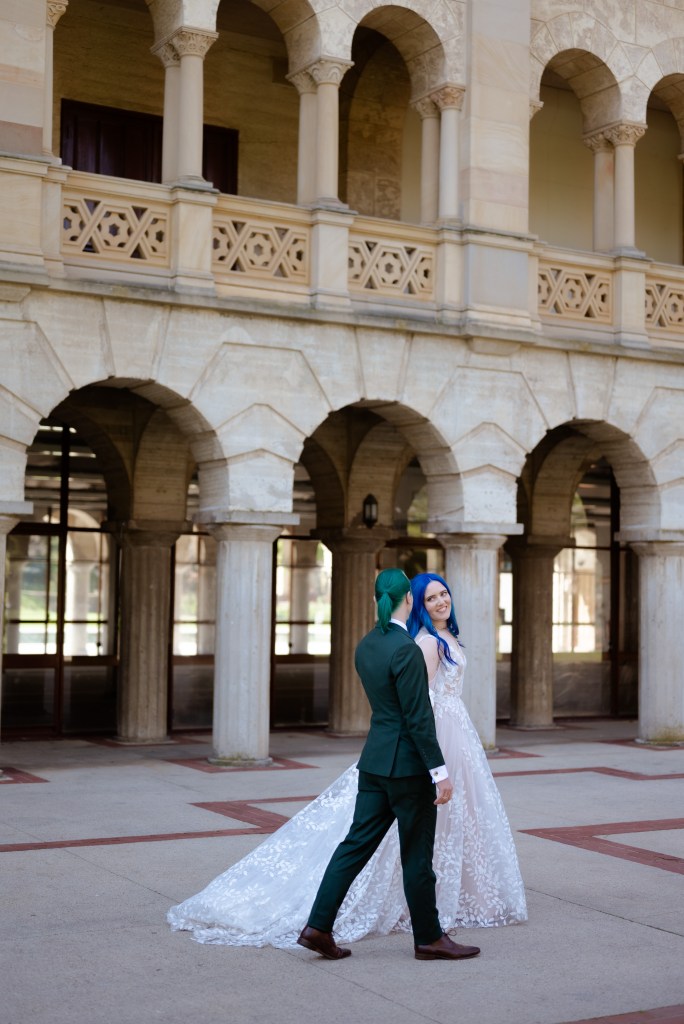
(In 2024 I finally gave it a rest and instead focused on getting married and buying a house!)
It is now the latter part of 2025, and I have begun a Graduate Certificate in Data Science. The data would suggest that I’ll abandon this after a couple units like I have all the other ones, but there are some key differences between this and my past endeavours.
The early 2020s were a period of deep and sometimes painful soul-searching for me (if you’ve read this blog you know all about that). I was seeking far and wide for passion, for meaning, for healing from past hurts, for a cause to devote myself to, and I was also seeking alternative career options. That’s a lot of pressure to put on any one aspect of life, and of course in hindsight nothing I could ever study would fill such a void.
I have learned some very key things and gotten some substantial answers that have primarily crystallised over the last 1-2 years (details in past blog posts). My Graduate Certificate (and potentially Graduate Diploma and/or Masters if I choose to progress) is not about that. My reasons for studying this are far more practical.
I’ve been doing software engineering for 10 years this year. I probably have at least 20 more to go. I don’t want to be doing the same thing I’m doing now for 20 more years. Data science sits very nicely in an intersection between my current work, and a new area of expertise to dive into. It can either amplify my existing career throughline or open sideways/diagonal transitions for me. It’s a relatively new field that still has plenty of things to discover within, it’s very practical to study alongside work, and it’s fast (only 1.5 years for the Masters). This is a rejuvenating career move, not anything else.
My prior study options were investigative and curious, and each of those areas have had different outcomes.
I do like reading about philosophy, but it’s something that I would like to be interested in more than I am actually interested in it. Reading philosophy forums online keeps that part of me satiated.
Game design and creative writing, well, I gave that a serious go for a solid year both with study and with writing and developing my own game. If my career takes me in the direction of game dev I’ll happily partake, but it’s not going to be the “side hustle” I imagined it as when I was in the throes of it two years ago. I channel this part of me into my TTRPG campaigns now, which require both game design and creative writing skills, come with a built-in appreciative audience (the friends you’re playing with), and can be worked on in a relatively low-effort, iterative/episodic manner. I do still have game ideas and story ideas every now and again, but being more familiar with the sheer amount of work that game dev requires leads me to burn through these creative drives in a different way.
And finally we come to chemistry. I adored chemistry when I was in high school. If there are alternate universes, there is a moment in my life that is undoubtedly a branching point. In late high school I went to a careers information event hosted by the school where you could speak to people from different careers to evaluate your own prospects and interests. I sat down with my chemistry teacher, Dr. Joyce, and told him how much I loved the subject.
He asked me, “Well, have you ever considered it as a career?”
Now, keep in mind, I had decided I was going to become a software engineer in about year 8. For a very large part of my adolescence I was absolutely certain I was going to become a game developer. So, in that moment, I mentally put away the question and told him of my existing plans.
What if I had properly considered the question? What if I hadn’t discarded it and actually thought about what I enjoyed doing, and where that could lead me? I’m convinced there’s an alternate universe where I give that proper consideration, and end up diving deeper into chemistry straight out of school.
This pivotal moment, I will be honest, is something I regret sometimes (not the outcome, because life has turned out pretty great, but the decision making process), but back then I was a heavily religious kid, and was used to fleeing from questions that made me uncomfortable or challenged my existing ideas. Also, I continue to firmly believe that as kids we’re forced to make life-spanning decisions far, far too early.
So I don’t live in that alternate universe. I live in this one. And chemistry keeps coming up. My 2022 studies in it gave me a taster, and I came out of that not wanting to continue, but that’s because I was looking at it from a career perspective. Chemistry is never going to be my career, but diving back into studying this year has made me miss it, and the feeling of understanding that comes with it.
I can just study it because I want to. For instance, I could do some sort of postgrad coursework degree that’s quicker than another undergrad and doesn’t waste my time with unrelated electives, and if I haven’t had enough by then, potentially go into research. The motivation would be to do a piece of research, make a contribution, and then return to my regular scheduled programming (wordplay!). Some people have kids, some start businesses, apparently my thing is studying. It would be something I do for my own fulfilment, without putting career pressure on it, and it would be for a limited period of time.
Of course, it is well known that I get excited about stuff and then fizzle out after a few months, so that’s why I’m writing this down now, so I can refer to it in a year or so when I’m done with data science study and compare my feelings then.
To conclude, I just looked it up and Dr. Joyce retired from teaching in 2016. I hope he’s doing well. Do people dedicate their theses? Maybe I’ll dedicate mine to him.
In my previous post, I resolved to examine the data accumulated in the contents of this blog to discern what experiences have so far made life meaningful and satisfying to me. In what was at the time a startling, true epiphany, I realised that my past efforts in documenting these things could be used to infer general principles that I could use in the future – my past self had unintentionally gathered data for me to use now. In the eight months since that post, I decided to sit with these pillars of meaning, and let them lead me. I decided to actively focus on cultivating experiences that leaned into them and feel the results, as well as recognise the relevant experiences that already exist around me and mindfully, intentionally focus on them.
The results have been quietly satisfying, at once subtle and deep. I listed the pillars of meaning in my previous post, but those were one-sentence descriptions. Let me expand on them somewhat.
My connections to the people I love. This refers not just to the obvious one of my love for Kiara, my life partner. I’m mostly referring to platonic love, since platonic relationships are the most frequent ones we have (unless we are incredibly lucky, or incredibly isolated). The connections should preferably be two-way, ones where I can put in effort to love and support the other, and in turn be loved and supported by them.
Travelling and seeing new places. When routines start to become stale, when the everyday experience of life starts to turn monotonous, travel is the best way of injecting a flood of novelty into it. Travel enables new experiences, new perspectives, which is of itself valuable and meaningful. Crucially, it also revitalises my enthusiasm for my “normal” life – by divesting myself of my normal routines and comforts, I learn what it is about those that I value, and therefore appreciate them more.
Music – the ordinary listening experience to form the foundation, and live shows as the capstone. Most of my creative expression tends to be word-based, or roleplay-based, both of which have rules and structure and a certain linearity to them, at least the formats I practice them in. Music has this as well, but its way of enabling emotions requires far less elaboration – music doesn’t need to introduce a relatable character for the listener to invest themselves in, spend time building that character up, and then have something perilous happen to them to make the listener fear for their life, just as one example. A song can hit you with a twenty-second arrangement that bypasses all of that and strikes directly at your emotions for no reason you can name. I value music for this so highly because it encourages me to break the bounds of my own storytelling. As for the impact of live shows, see my previous posts for exhaustive detail on this.
Creating and storytelling, on my own but especially with others. Stories are fun. Making up worlds and characters is incredibly fun and rewarding. Doing it with your friends makes it doubly so; books exist to be read, after all. But there is a deeper value cultivated by storytelling, or the consumption of stories: empathy. Stories allow us to imagine and put ourselves in the place of people we wouldn’t normally identify with, and in doing so humanise them. I don’t mean to imply that my storytelling does or even aims to do this on a regular basis, but it is a reason that I value the practice over just the entertainment and escapist aspects of it.
You may have noticed that these pillars have some overlap, and indeed they can play off of each other and intertwine. Storytelling with people you love hits pillars 1 and 4. Travelling to see a music festival or concert hits pillars 2 and 3. I had the unique experience last year of travelling with Kiara to see Coheed and Cambria, a band we both love that creates album-length scifi stories with their music. This incorporated all four pillars of meaning to varying degrees, the travel perhaps the least since we were only going to other Australian capital cities which we’d seen before.
The last eight months have had many incredible experiences, including my own wedding and, just recently, Kiara and I buying our first home together. These do potentially skew my perspective on the intervening time somewhat, especially the wedding – have I been getting such emotional satisfaction from my relationships with the people around me because of this huge event that highlighted them all, or has the event served merely to amplify what was already there? It is probably, hopefully, both.
By far the pillar that I’ve directed most of my attention to is the first. I would say my musical and storytelling habits and immersion are already well-trained and quite deep (though I have picked up my guitar and dusted off my amp for the first time in a long time and that has been quite fun). Travel, of course, requires organisation and funding that makes it more discrete in implementation, whereas social relationships can be continuously nourished by small daily or weekly steps. Some of these have borne more fruit than others; relationships are of course two-way, and require compatibility, response and effort from both sides. If they are not reciprocated, there’s little I can do beyond remaining open to that reciprocation in the future.
I am calling them relationships because the last few months have broken down my categorisation of friendships somewhat, and I am starting to see relationships as existing on something of a spectrum, or a grab bag of behaviours that apply differently to different people. Obviously certain of these behaviours are restricted to Kiara, but take, as an example, hugs. Hugs are great. I hug Kiara, and I hug my family, and more and more over the last year or so, I hug some of my friends. Some of my friends welcome hugs, others are more reticent, and I’ve been taking care to observe their reactions and whether they initiate hugs or not. Is my friendship with those that don’t prefer hugs lesser because of it? Of course not. Some of these “non-huggers” include Adelaide friends that I’ve known for many, many years. Video games often express progress in relationships in a linear manner, and physical contact like hugs tends to be a milestone in those. Real life is not like this. Relationships contain an assortment of different ways of showing affection that need to be tailored to the particular person, and not all those ways can be neatly categorised.
One of the things I miss about Antioch is that people there were not shy about showing physical affection in platonic contexts. It was not uncommon to witness people cuddling up while having a deep conversation. In the last year or so I’ve started to miss that. One of the things I’ve learned from my therapist is to ensure that I’m not “dead from the neck down”. Most often this refers to exercise, but I apply it here as well. Laughter and sharing stories are great, but sometimes you just want to hug your friends. It’s the music thing again – some things have a way of bypassing more cerebral expression and hitting the emotions directly. Hug your friends, y’all (if they want you to).
Let me return to the point. I’ve focused on cultivating relationships to varying degrees of success, and it’s made me pay attention to how I feel about different friendships not just in terms of the person on the other end, but in the length of the friendships. It’s been a long time since I’ve made a new one-on-one friend, and for a good while that novelty was exhilarating. I would get nervous before meeting up, dwell in gratitude after they’d left, and impatiently look forward to the next time.
Contrast that with a gaming session with eg any of the Adelaide crew, which has a drastically different timbre. There isn’t that nervous excitement, that not knowing, that unpredictability. Instead, there’s total comfort, familiarity, safety and trust. I can be my fully authentic self around them with zero filter and know that I am safe. And Kiara is basically an extension of myself at this point – we are of course different people, but our lives are so entwined that it is like we are two minds in the same body, or two planetoids orbiting a common centre of gravity, so that they form a single gravity well.
That sense of novelty is starting to ebb away from the newest friendship I’ve made, and it is beginning to morph into something a little more familiar. I have mixed feelings about this. That novelty, that not knowing what to expect and the thrill of uncertainty around whether our friendship would solidify is what heightened my awareness of it in a way that I haven’t felt in many years. It has been delightful to feel again, and I’m going to miss it when it’s gone. Does that diminish the appeal of the friendship? Of course not. When I think about the faces and voices of people that surround me my heart fills with gratitude, whether I’ve known them for a mere few years or for a significant portion of my life. But it has been delightfully interesting to see what my emotions have been doing as this new person has entered my sphere.
Novelty, then, and diversity of experience has been a keystone of the months since my last post. I do wonder frequently if this is an overriding factor, something that influences satisfaction and meaning as much as or even more than the pillars I’ve already identified. Novelty does come up in the pillars themselves. Travel, obviously, is that, and social connection and storytelling contain it as well. But I wonder, if I didn’t travel, didn’t make new friends or nurture existing ones, listened to the same music (which, to be fair, I tend to do anyway; it’s one area that I like to dive deep and narrow), and didn’t do much storytelling but experienced novelty in other ways, would I still feel like life was satisfying and meaningful? I struggle to think of how novelty might be introduced without hitting those things that I’m deeply interested in. New, single-player video games that don’t have significant story components, maybe. A crazy change of diet. A new job, maybe. I don’t know. I am certainly not going to discard the pillars so soon after I’ve discovered them in an attempt to validate this; that sounds miserable, and while I like to be a little bit scientific in my pursuit of meaning and joy, a lot of this is driven by emotion and instinct, not analysis. Still, it’s something to keep in mind and pay attention to.
I don’t consider the question of meaning and joy solved, and I doubt it ever will be completely. I have found parts of the answer that sustain me for the time being, but I remain open to future changes.
Time
A final anecdote, and another digression. I have, for the first time (and this is a novelty of a distinctly more neutral, or perhaps even negative variety), noticed my age. More specifically, I am now frequently associating with people significantly younger than me. When they tell me about some of their experiences and feelings, it is tempting to put them in an “I’ve seen that before” box, and I can imagine that impulse only increases the older one gets. I can think back to how I felt at that age and in that context; I can imagine that I understand how they are feeling now. We have all had the frustrating and demeaning experience of an older person acting as if they understood how we felt. Offering advice and suggestions when they are asked for is one thing, but presuming to understand how someone else feels, regardless of age, just because you have experienced something you believe is similar, is presumptuous in the extreme and an urge that needs to be moderated.
When we are tiny children, every minor setback is the worst thing that’s ever happened to us, which is why we bawl and scream (apart from not knowing how to communicate otherwise, having undeveloped brains, etc). This doesn’t stop as we get older, and so something that is happening to someone for the first time (a breakup, to take a contrived example that I have never actually experienced) that we have gone through many times over will feel completely different. Again, we’ve all had the horrible feeling of our feelings or perception being dismissed by someone older who has seen what they think is the same thing one too many times. I have been surprised by the urge not to dismiss (I would hope I have more empathy than that), but to think I understand by only hearing a general situation. I have offered unsolicited advice a couple of times and have only realised afterwards. An awareness of the age difference between me and another person is to some degree inevitable, but I can serve not to exacerbate it by not being an ass, even accidentally. It’s something to note.
Popular culture puts the spotlight on people in their teens and 20s as the stars of the show of life. People far older become mentors and wise teachers, especially in fantasy. People in between this are far less clearly depicted (or perhaps I just need to expand my sources). I would like to fully accept and be at peace with the passage of time and its effects on me, but I won’t lie and say that I’ve reached that point, or even that I’m actively working on it. I’ve noticed it, and the media’s messaging around this does needle me and affect my self-esteem, but it is something that I’m trying to put aside for the most part and just focus on doing what I aim to do: live a satisfying, meaningful, and joyful life.
In early 2023, I made the decision to begin writing and developing my own games. This is something I’ve wanted to do for many years, and life circumstances this year were finally right. The game industry remains competitive as always, and while attaining a job at a game studio remains a huge goal of mine, opportunities in Australia, and especially Western Australia, where I’m based, are rare.
Making my own games achieves three things:
It results in portfolio pieces that I can use to aid my future employment prospects;
It gives me practice at the actual nitty-gritty detail of game development, increasing my familiarity with the tools and processes involved, and my understanding of the obstacles unique to game dev; and most importantly,
It allows me the opportunity to express myself creatively, and bring the stories in my head to life on my own terms.
In 2023 I pursued three different aspects of game development: making and releasing my first game, studying game design at a tertiary level, and attending my first game developer conference, GCAP. The rest of this post will focus on what I learned from each of these endeavours.
Making and Releasing a Game
In the first half of the year, I was solely focused on making and releasing The Symbol, which is a text-based narrative game that came in at a word count of roughly 30,000 words. I spent February mostly ideating and getting the large-scale pieces of the story straight in my head, and then actual writing and implementation took just over 3 months, from March to July.
Development Constraints
3 months is a short development time for a game, and, well, The Symbol is a short game (it can easily be played in a single sitting). I made several decisions which let me successfully constrain development time, as I’m wary of overcommitting to ambitious projects that drag on for many months or even years.
The first such decision was making the game text-based. I’m a writer at heart, and I’m primarily interested in telling stories through games (more on this later). The text-based format allowed me to forgo any reliance on artists or other people to add visuals to the game. I could add all the visuals myself through the writing, and leverage the ultimate graphics engine: the player’s imagination. Making it text-based meant that “development” largely consisted of what I can already do and already love doing: writing.
The second constraint was more external: I enrolled in tertiary study of game design and creative writing that was due to start in July, and so I knew I had to get the game done before then, as I wasn’t going to have the time to manage both things at once. This deadline really helped motivate me towards the end of the project.
Thirdly, while this was less of a conscious decision and more of a happy coincidence, the story of The Symbol is one that has been kicking around in my head for years. The Symbol explores two key concepts: a suicidal god, and an inversion of the god-disciple relationship. This results in a highly interesting situation where you, as the disciple, hold power over the Symbol, who wishes to die, and the Symbol must become your supplicant in the attempt to get what it wants.
Having all of this key underlying material meant the ideation phase was very short, as most of the framework and key themes were there. This helped me accurately plan and stick to a timeline, as ideation can otherwise be very open-ended as the writer explores broadly until they find the driving factors behind the story.
The Twine Engine
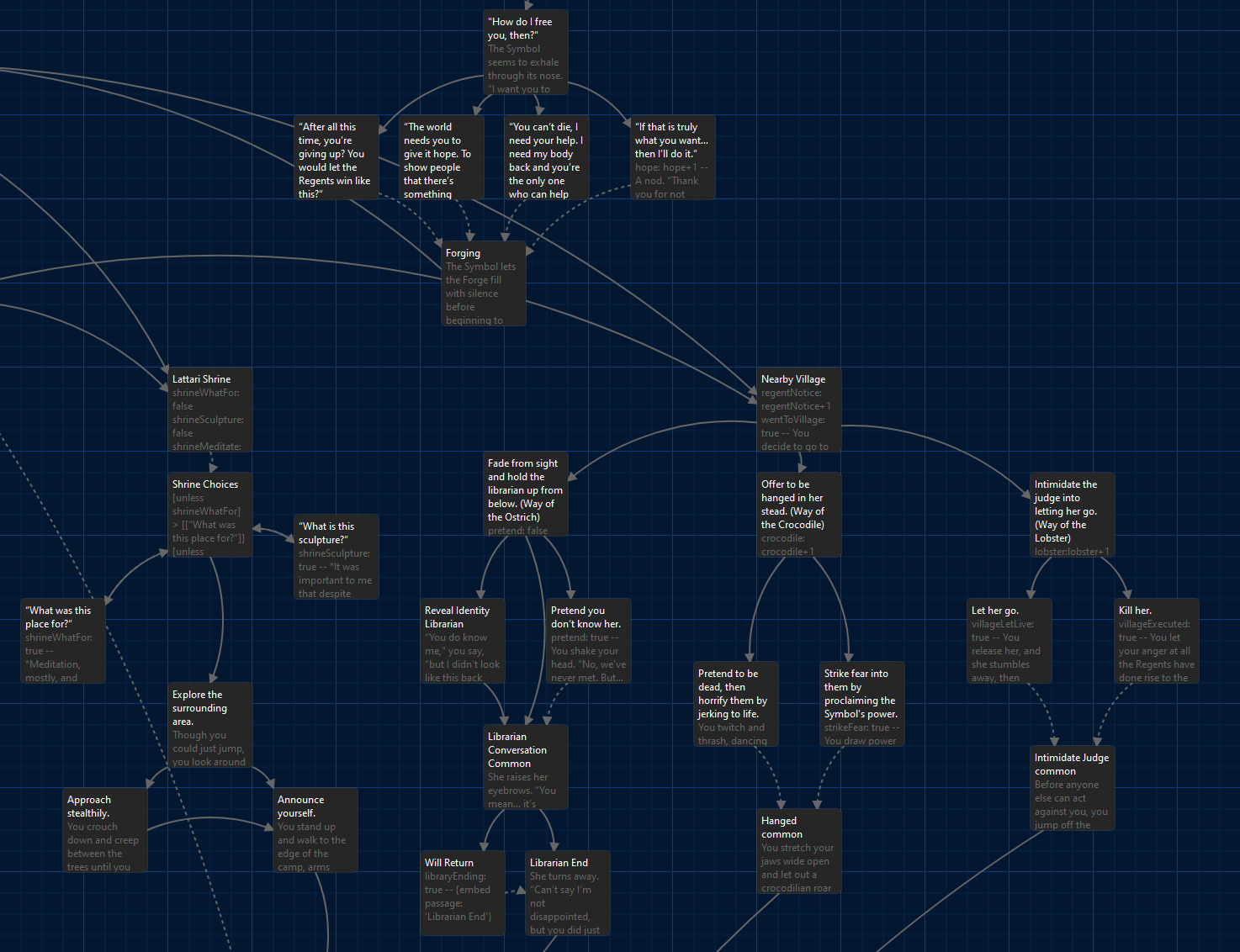
I used Twine as the engine for The Symbol, as it’s perfectly suited to the type of game I was making. I found the engine very simple to use, as it consists of making nodes of text (with an optional variables section) and linking them to each other. Here’s an example of what it looks like:
It’s worth noting that I actually wrote most of the game in a word processor, and then transferred the narrative into Twine once I had most of it together. This decision had pros and cons: writing in a word processor makes it far easier for me to get in the zone. In the Twine view, the actual text entry area is a small part on the side of the screen, and having to write the whole thing in that view would have been distracting and annoying.
The flipside of this decision was that after the fun “writing” phase was done, the “implementation” phase began where I spent a lot of time copypasting text into nodes, linking nodes together, and setting up variables to keep track of player decisions. The decision to write in a word processor meant these two phases were almost entirely separate, whereas if I’d written in Twine itself, they would have blurred together a bit more.
I’m not sure what I’ll do next time round yet, but I think writing in a word processor was the right way to go for my first time using Twine, as it prevented any implementation issues from derailing me from writing. There’s a good chance my next game won’t use Twine, so I may sidestep this conundrum entirely.
One last note on Twine: the node-based view in the screenshot above was intuitive, but became cumbersome as the number of nodes increased. Twine doesn’t offer a way to “condense” sections of nodes down, you just have to arrange them by clicking and dragging. Still, as a very lightweight engine, it did exactly what I needed it to. I kept the development effort minimal by not messing around with CSS or anything fancy, and just used the default settings. My software development experience came through in this project: I was very much striving for the smallest thing I could make that was still a game, and that primarily utilised my writing skills.
Interactivity and Branching
I learned first hand that compared to writing linear stories, even stories with a little bit of branching can quickly grow exponentially in terms of complexity. The Symbol is pretty low in terms of actual branching, but keeping track of player dialogue and interactions and ensuring that those were reflected going forward was more effort than I predicted, and I’m lucky that I kept the initial scope of the game small, otherwise I would have had to cut stuff once I approached my self-set deadline.
Overall, I finished The Symbol with a combination of relief and satisfaction. It felt like a strong step in the right direction, and it affirmed for me that just making the games I wanted to make was the surest way to achieve my game development goals.
By the way, if you’d like to play The Symbol, you can find it here. It plays in the browser, so no download required, and it’s free!
Studying Game Design at Uni
Practically the week after I finished The Symbol, the study period I was enrolled in started. I had enrolled in two individual units through Open Universities Australia, as I’ve learned from my uni explorations over the last few years that degrees take too long and at this point in time I learn far better by diving in and getting my hands dirty than by studying.
Nevertheless, I wanted to see what formally studying game design would yield, and unfortunately I was disappointed. The content was light-on and lacked rigour, and it felt more like a guided opportunity to develop game design documents and get feedback rather than actually learning the underlying rules of game design. I’ve learned far more about planning and executing projects through my software career, so it’s possible I’m not the target audience for an introductory game design unit. That said, I did learn a bit about the phases of game production, and about considerations that should go into designing a game.
I came out of that period of study in September wishing I’d spent those 3 months making another game instead! But, negative data is still data, and I know now that I’m not suited to the type of study that was offered in that unit.
Attending GCAP
In October, I attended Melbourne International Games Week, which began with the GCAP conference. Three days of attending talks and panels and meeting with new people left me exhausted, but it was a good insight into what goes on in the Australian game industry.
All the talks I attended were extremely good. I ended up following the Narrative talk track most of the time, to no one’s surprise. Highlights included Pacing in Narrative Games, a talk by Mads Mackenzie, the developer of Drăculești, and Lower Your Character Limit: Getting Bigger Laughs with Fewer Words, a talk on humour and comedy by Bones Draqul Hillier, a narrative designer at Mighty Kingdom that works on Star Trek: Lower Decks. These people were inspirational to hear speak, and I learned a lot from getting diverse perspectives on many aspects of game development, not just the writing side.
Just going for the educational aspect of the conference was valuable, and would have been worth the expense by itself. However, I also pursued networking opportunities while I was there, and learned a lot from this experience as well.
GCAP had set up MeetToMatch, a platform where you could book one-on-one meetings with people, and as someone who struggles socially with making small talk and making new connections, this was really helpful, as I could go into a meeting knowing who I was speaking with and why. I definitely flubbed a few of these meetings, as I struggled to find things to talk about or keep conversations going. I learned that networking is hard. I have never been a person that enjoys striking up conversations with strangers, but that’s exactly what you have to do to network. More than learning any technical skill, this is going to be the most difficult part of being involved in the game industry for me, because the networking side is more important than I gave it credit for. I had the chance to catch up with Anthony Sweet, a game designer that I already knew from Perth, and he told me that when people look for new hires, they want someone that they know they can get along with and work with for 8 hours a day, and those conversations happen in places like GCAP, not at the interview table. It seems I need to lean into this in order to make my dreams of working at a game studio a reality, so that was a powerful lesson to take away for next year.
I’ll finish up this section by sharing the highlight and lowlight of my networking experience at GCAP. The lowlight was for sure the Australian Game Developer Awards, because in addition to the social constraints of networking, it all took place in a packed venue with music so loud you had to yell to be heard, and everyone speaking over each other trying to be understood. Anyone who’s heard me speak knows that I have a quiet voice, and trying to raise it for extended periods of time is really hard for me. The AGDAs are probably the sort of thing that is more enjoyable if you know people already, and can just attach yourself to someone and follow them around (at least for an introvert like me).
The highlight, however, consisted of two conversations I had at the conference itself: one with Anthony, as I mentioned before, because he gave me some really good advice and is generally an extremely welcoming and friendly person, and the other was the opportunity to meet with Samantha Cable, Head of Narrative at Spoonful of Wonder, who are currently working on Copycat. I think everyone will agree that we need more cat-based games in the world, and talking to Sam about Copycat was an extremely enjoyable experience. She was really approachable and expressed interest in hearing about my projects too, so that was a fun, two-sided conversation.
I would say my overall impressions of GCAP were mixed, but I hope to attend it, or an event like it, again next year.
Next Steps
So, with all that learned, and 2023 approaching its end, my next steps are:
Remain Open to Opportunities
Since the industry is so competitive, it always helps to have the resume primed and ready to apply to job postings that come up. This is a bit of a lottery, but I’m standing by and ready to pounce should something emerge.
Network Locally
Perth has a game dev community, and I’m already a little bit involved, mostly by lurking on the Let’s Make Games discord. I’m going to make an effort to attend more game dev meetups and get to know some of the other game devs in Perth.
Make Another Game
The obvious answer, and the most important one. Another portfolio piece will help with job applications, and I can take the lessons I learned from The Symbol and make something slightly more ambitious. I’m currently experimenting with a variety of things, from an eldritch space simulator to a Cthulhupocalypse visual novel, and hope to have my direction solidified by the end of the year. I know for sure that I still want it to be primarily a narrative-driven effort, but as to exact story and genre, that’s up in the air.
Conclusion
It’s been a big year of learning for me. Making it in the game industry often feels like an asymptote, in that no matter how close you approach, the target is always that little bit further away. Nevertheless, there’s no denying I’ve made strides this year: actually making a game, exploring formal study options, and diving into the industry through a big conference.
I’m on the right track. All I can do is keep following my passion for telling stories and remain open to what comes my way.



 Dominik Jarco